Blue Carbon: Marine Ecosystem Credits
I. Definition
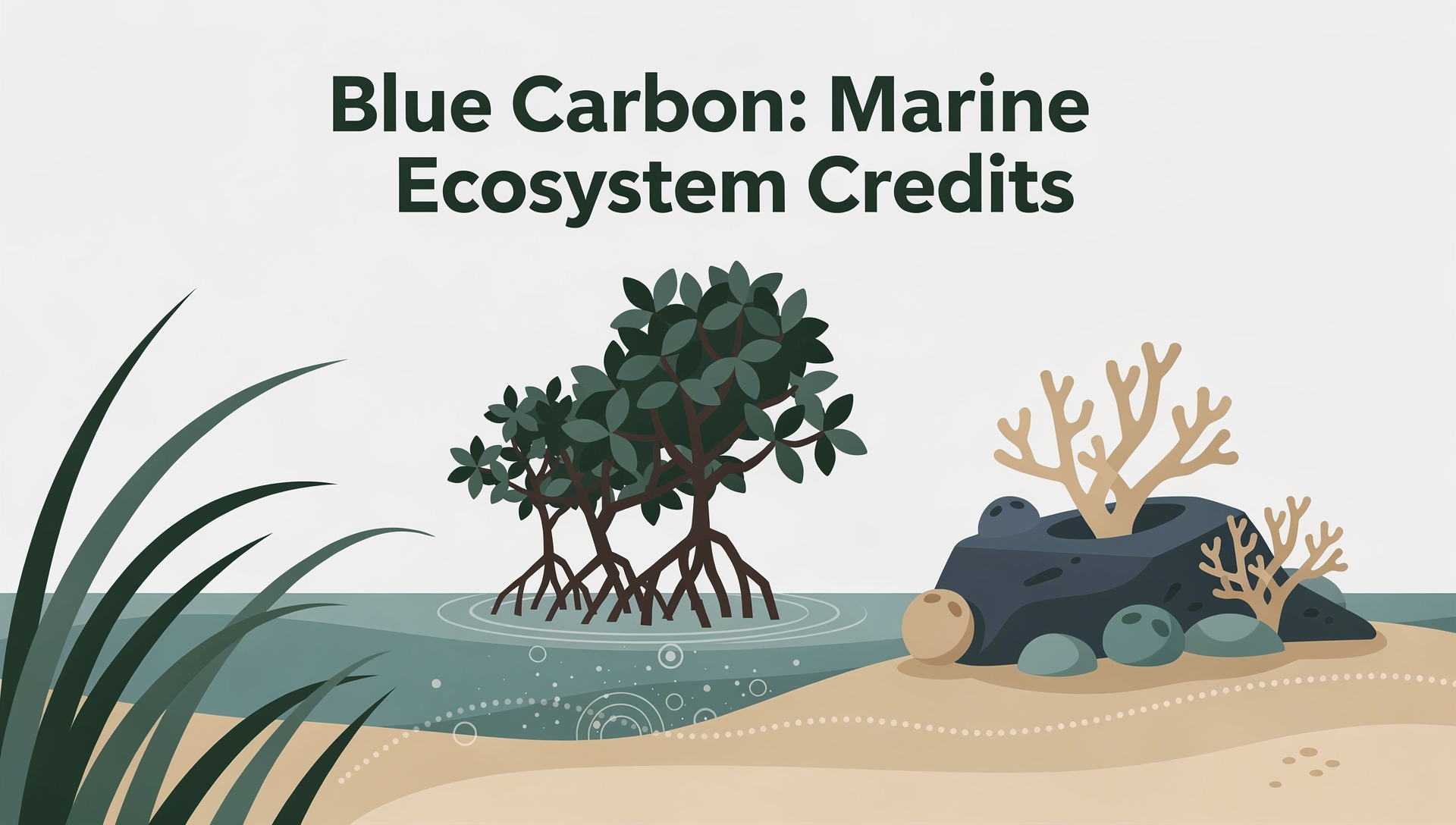
Blue carbon refers to carbon captured and stored by marine ecosystems such as mangroves, seagrass meadows, and salt marshes.
Marine ecosystem credits are carbon credits generated by protecting, restoring, or sustainably managing these ecosystems.
In simple terms: when a coastal ecosystem absorbs and stores CO₂, this climate benefit can be measured, verified, and converted into a carbon credit.
II. Context
Marine ecosystems play a key role in climate regulation.
Blue carbon ecosystems store large amounts of carbon in plants and in marine sediments, often for hundreds of years.
If these ecosystems are destroyed, the stored carbon is released back into the atmosphere.
To prevent this, projects focus on conservation, restoration, or improved management of coastal areas.
When done correctly, these actions avoid emissions and increase carbon storage.
Marine ecosystem credits are part of the broader carbon market.
They require strict measurement, reporting, and verification (MRV) to prove that carbon storage is real, additional, and long-term.
Because these projects happen in sensitive environments, data quality and transparency are critical.
Without clear evidence, claims about blue carbon benefits cannot be trusted.
III. Why it matters
At Orizscore, we see blue carbon as a powerful opportunity, but also a responsibility.
Marine ecosystem credits can only work if proof comes before promises.
The main risk is over-claiming.
If carbon storage is not measured correctly, credits lose value and credibility.
If permanence is not proven, trust collapses.
This raises key questions:
Can we track carbon over long periods?
Can we prove that ecosystems are really protected?
Can we show that benefits are not reversed?
For blue carbon to scale, reliable data, traceability, and transparent methodologies are essential.
Strong evidence is what turns nature-based solutions into credible climate action.
IV. Related terms
- Carbon Credits
https://www.orizscore.com/blogs/carbon-credits - Nature-Based Solutions
https://www.orizscore.com/blogs/nature-based-solutions - GHG Protocol
https://www.orizscore.com/blogs/ghg-protocol
V. Example
A coastal region restores degraded mangrove forests.
Mangroves absorb CO₂ and store carbon in their roots and surrounding sediments.
Scientists measure the increase in carbon storage over time.
This data is verified through an approved MRV process.
The verified climate benefit is converted into marine ecosystem credits.
Companies purchase these credits to compensate for part of their emissions.
The result is clear: protected ecosystems, measurable climate impact, and transparent proof of action.